Bibliography vs Works Cited: What's the Difference?
Understand the difference between a bibliography and Works Cited page. Learn when each is used, how they're formatted, and how annotated bibliographies work.
- bibliography
- works cited
- citation
- reference list
- mla
- chicago
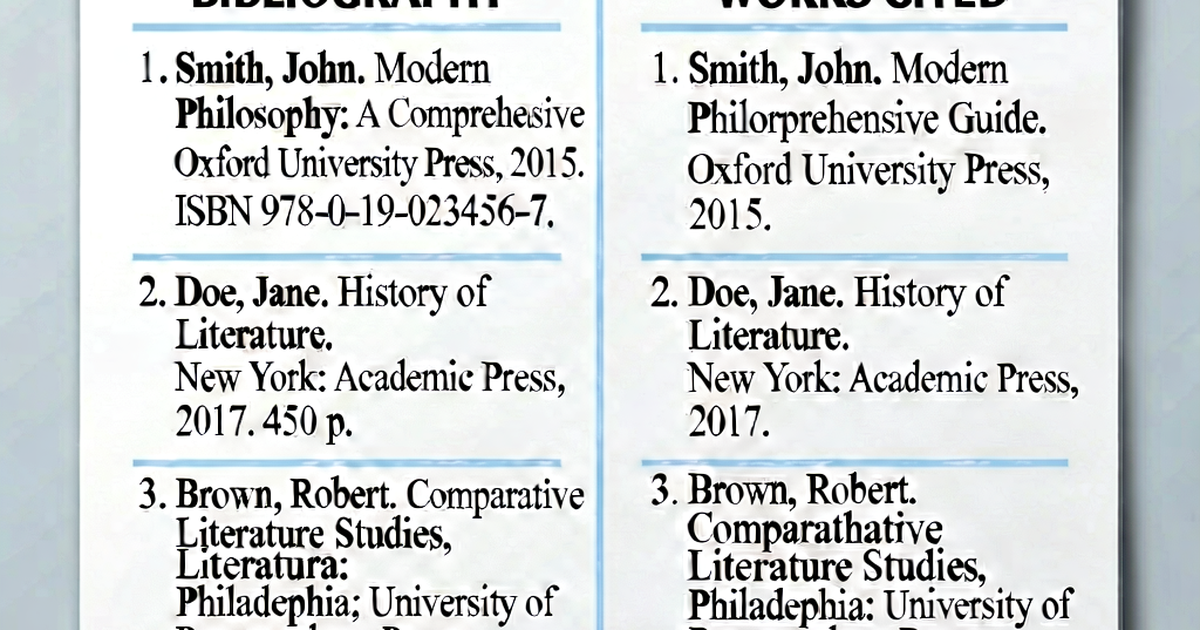
“Bibliography” and “Works Cited” are often used interchangeably, but they have distinct meanings depending on which citation style you’re using. Here’s what each term means and when to use it.
Works Cited
Works Cited is the term used in MLA style (Modern Language Association). It lists only the sources you actually cited in your paper — every source that appears in an in-text parenthetical citation must also appear in the Works Cited, and nothing extra.
When to use: Any MLA-formatted paper. This is always the correct term when writing in MLA style.
Works Cited

Kahneman, Daniel. Thinking, Fast and Slow. Farrar, Straus and Giroux, 2011.

Orwell, George. 1984. Signet Classics, 1961.

Roberts, James. "How Neural Networks Learn." Towards Data Science, 12 Nov. 2025,
     towardsdatascience.com/how-neural-networks-learn.
Reference List
Reference List (or References) is the term used in APA style (American Psychological Association). Like Works Cited, it includes only sources cited in the body of the paper.
When to use: Any APA-formatted paper. Title the page “References” (centered, bold).
References

Kahneman, D. (2011). Thinking, fast and slow. Farrar, Straus and Giroux.

Roberts, J. (2025, November 12). How neural networks learn. Towards Data Science.
     https://towardsdatascience.com/how-neural-networks-learn
Bibliography
Bibliography is used in two contexts:
1. Chicago style (Notes-Bibliography system) — the bibliography page functions like Works Cited or References, listing only cited sources. The term is specific to Chicago’s footnote/endnote system.
2. General academic usage — sometimes “bibliography” is used loosely to mean any source list at the end of a paper, regardless of style.
Strict meaning: In a traditional bibliography (especially in research and library science), you may include sources you consulted but didn’t directly cite — background reading that informed your understanding. This broader definition is most common in book-length works and dissertations.
Bibliography

Kahneman, Daniel. Thinking, Fast and Slow. New York: Farrar, Straus and Giroux, 2011.

Orwell, George. 1984. New York: Signet Classics, 1961.
The practical distinction
| Feature | Works Cited (MLA) | References (APA) | Bibliography (Chicago) | Bibliography (general) |
|---|---|---|---|---|
| Style | MLA | APA | Chicago N-B | Any |
| Includes uncited sources? | No | No | No (usually) | Sometimes |
| Correct term by style | Yes | Yes | Yes | Informal |
For most student papers: use the term your style guide specifies.
- MLA → Works Cited
- APA → References
- Chicago → Bibliography (Notes-Bibliography system) or References (Author-Date system)
Annotated bibliography
An annotated bibliography adds a brief summary or evaluation paragraph after each citation entry. It’s assigned to help you engage with your sources before writing.
MLA annotated bibliography example:
Works Cited

Kahneman, Daniel. Thinking, Fast and Slow. Farrar, Straus and Giroux, 2011.
     Kahneman draws on decades of behavioral economics research to show how human
     decision-making is systematically biased. Chapters 11–14, on availability and
     representativeness heuristics, are most relevant to this paper's argument about
     risk perception in medical decision-making.

Orwell, George. 1984. Signet Classics, 1961.
     Orwell's dystopian novel presents a political system built on language
     manipulation. Its analysis of doublethink is foundational to discussions of
     political rhetoric and propaganda.
APA annotated bibliography example:
References

Kahneman, D. (2011). Thinking, fast and slow. Farrar, Straus and Giroux.
     This book synthesizes research on cognitive biases, particularly the distinction
     between fast, intuitive thinking (System 1) and slow, deliberate thinking
     (System 2). The risk perception chapters are directly applicable to this study.
Selected bibliography
A selected bibliography (common in book publishing and journalism) lists only the most important sources — not every source consulted or cited. This is editorial judgment, not an academic standard. Don’t use it for class papers unless specifically assigned.
Common mistakes
Wrong term for the style: Calling an APA reference list a “bibliography” isn’t technically wrong, but using the style-specific term shows you know the conventions.
Including uncited sources in Works Cited / References: In MLA and APA, every entry must correspond to an in-text citation. Sources you read but didn’t cite belong in a bibliography (if at all).
Forgetting the bibliography in Chicago: Chicago papers use footnotes for citations — students sometimes forget the bibliography page entirely, thinking the footnotes are sufficient.
Generate formatted reference lists at citefast.io.
Related reading
-
How to Cite a Website: APA, MLA, and Chicago Formats
Learn how to cite a website in APA 7, MLA 9, and Chicago style. Includes templates, examples, and how to handle missing authors, dates, and URLs.
-
Chicago Citation Style: Notes, Bibliography, and Author-Date
Learn Chicago citation style including footnotes, endnotes, bibliography format, and author-date system. Covers books, journals, websites, and common sources.
-
MLA Citation Format: Complete Guide to MLA 9th Edition
Master MLA 9th edition citation format. Covers Works Cited entries for books, websites, articles, and films plus in-text parenthetical citation rules.